B2B data providers compared: who sells what and how to pay for it
Quick answer
B2B data providers sell contact and company data in four ways. ZoomInfo and Cognism sell seats by quote, and Cognism stresses phone-verified mobiles and European coverage. Apollo.io lists seat prices with credits. Lusha and UpLead charge per credit, and FullEnrich only for data it finds. BlitzAPI and MoltSets charge a flat fee. Pay per find below your break-even volume and a flat fee far above it. Test two or three on your own rows.
 By Tim Scheuer, Co-founder of Oxygen · Updated October 28, 2026
What is a B2B data provider?
A B2B data provider sells facts about companies and their staff: work emails, phone numbers, job titles, company size and industry. Sales teams buy from these data vendors to find buyers and fill gaps in their CRM (customer relationship management system).
Some sell from a database of their own. Others run a waterfall, asking several databases in turn, or sell API access for a flat monthly fee. An API lets your own code or AI assistant pull the data.
Which B2B data providers are there?
The table compares seven B2B database providers that sell from their own data: ZoomInfo, Apollo.io, Cognism, Lusha, Kaspr, UpLead and RocketReach. Every fact and count is the provider's own claim, checked on 28 October 2026. For platforms that add signals and outreach on top, see the best sales intelligence platforms.
Seven B2B data providers compared from their own pages
Each provider's own claims, checked on 28 October 2026. A credit pays for one reveal, export or lookup. A direct dial is a desk line that reaches the person; intent signals are signs a company is researching a topic.
| Provider | Data it sells | Regions it documents | How you pay | Free plan or trial | CRM integrations |
|---|---|---|---|---|---|
| ZoomInfo | Emails, direct dials, mobiles, company data, intent signals | Six regions with counts, such as 157.8M+ contacts in North America | Per seat, plus one credit per exported profile; sales packages by quote | Free trial; ZoomInfo Lite free for new users | Salesforce, HubSpot, Microsoft Dynamics, Marketo |
| Apollo.io | 240M+ contacts, 30M+ companies: emails, mobiles, direct dials | Global; counts by region in the app after a free sign-up | Per seat: Basic $49 billed yearly or $65 monthly; email 1 credit, phone 8 | Free plan, 75 credits a seat a month; 14-day trial | Salesforce, HubSpot, Outreach, Salesloft |
| Cognism | Emails, phone-verified mobiles, company data; intent on Pro | Director level and up in Europe and the US | Package with 5 seats and credits, 1 per revealed contact; quote only | None on its pricing page; demo | Salesforce, HubSpot, Pipedrive, Microsoft Dynamics |
| Lusha | 515M+ contacts, 29M+ companies: emails, direct dials, mobiles | North America, EMEA (Europe, the Middle East and Africa), Latin America, Asia-Pacific; 132M+ US contacts | Credits: email 1, phone 5, no match free; from $37.45 a month billed yearly | Free plan, 40 credits a month | Salesforce, HubSpot, Pipedrive, Zoho, Dynamics |
| Kaspr | Emails and phone numbers via a Chrome extension or CSV | Europe: 200M+ European B2B contacts | Per user: Starter $65 a month, or $49 billed yearly; unlimited B2B emails under fair use, 100 phone credits a month | Free plan, 15 email and 5 phone credits a month | HubSpot, Salesforce, Pipedrive, Zoho |
| UpLead | 200M+ contacts with emails, mobile direct dials, 19M+ companies | Global, by its own description | Per contact: 1 credit buys email and mobile; $99 a month for 170 | 7-day trial, 5 credits | Salesforce, HubSpot, Zoho, Pipedrive, Dynamics 365 |
| RocketReach | 700M profiles, 60M companies: emails and phone numbers | Worldwide, by its own description | Per seat: Pro $52 a month billed yearly, 3,600 exports a year | 5 free lookups | Salesforce, HubSpot, Outreach, Salesloft, from Pro |
How do B2B data providers get their data?
They mix public web pages, licensed partners, data their own users share and their own checks. As Apollo.io's own page puts it, no single data provider has everything. Four of them describe their sources like this:
- ZoomInfo: software reads public information on over 28 million sites and domains a day. Data partners and 200,000+ ZoomInfo Lite users add more.
- Apollo.io: 2M+ users who connect inboxes and CRMs, third-party data providers, and public web data it crawls.
- Lusha: members who share contacts from email signatures, licensed partners and public business data. It says it does not scrape social platforms.
- Cognism: press releases, company websites, news and public registries, then machine checks, do-not-call screening and manual review.
Sources: ZoomInfo: data sources, Apollo B2B data: sources, coverage and GDPR, Apollo data and waterfall enrichment, Lusha FAQ: data, credits, waterfall and compliance, Cognism: about our data
How do you choose a B2B data provider?
Start from your buyers, not the database size. Check five things, in this order:
- Region: compare published counts for your countries. ZoomInfo and Lusha publish counts by region, and Kaspr cites 200M+ European contacts.
- Field: calling teams need mobile numbers, and email-first teams need verified work emails.
- Volume: count the values you need found each month, per field. That number picks the buying model.
- Price: check what a phone number costs, such as 8 credits at Apollo.io and 5 at Lusha.
- Compliance: read the privacy page. Cognism, for one, screens numbers against do-not-call lists in 12 countries.
Sources: ZoomInfo: our data, with counts by region, Lusha FAQ: data, credits, waterfall and compliance, Kaspr: our data and its sources, Apollo pricing, credits and FAQ, Cognism compliance: GDPR, CCPA and do-not-call lists
Are data providers moving away from seat pricing?
In OXYGEN co-founder Tim Scheuer's view, yes: data has become a commodity, and seats no longer fit software that agents run. He said so in an August 2026 LinkedIn post on trends from studying 80+ GTM (go-to-market) tools.
Data companies are becoming waterfall companies, he wrote, naming BetterContact and FullEnrich. Seat pricing is giving way to usage-based pricing, as at OXYGEN, or a flat fee, as at BlitzAPI and MoltSets. "Nobody wants to pay per seat for software an agent operates."
His 9-step GTM framework, posted three days later, sets the order for buying contact data. Bring your own data vendor subscriptions to OXYGEN, let its managed credits fill the gaps, and verify cheaply. A second check handles catch-all addresses, on domains that accept mail for any name.
Both posts are dated views from studying tools, not measured comparisons. They do not show that a waterfall finds more of your contacts or costs less. The prices below come from each provider's page today.
Sources: Tim Scheuer on LinkedIn: six trends from studying 80+ GTM tools (August 2026), Tim Scheuer on LinkedIn: the 9-step GTM framework (August 2026), BetterContact pricing and waterfall, FullEnrich pricing in US dollars (its machine-readable page), BlitzAPI pricing and fair use policy, MoltSets pricing
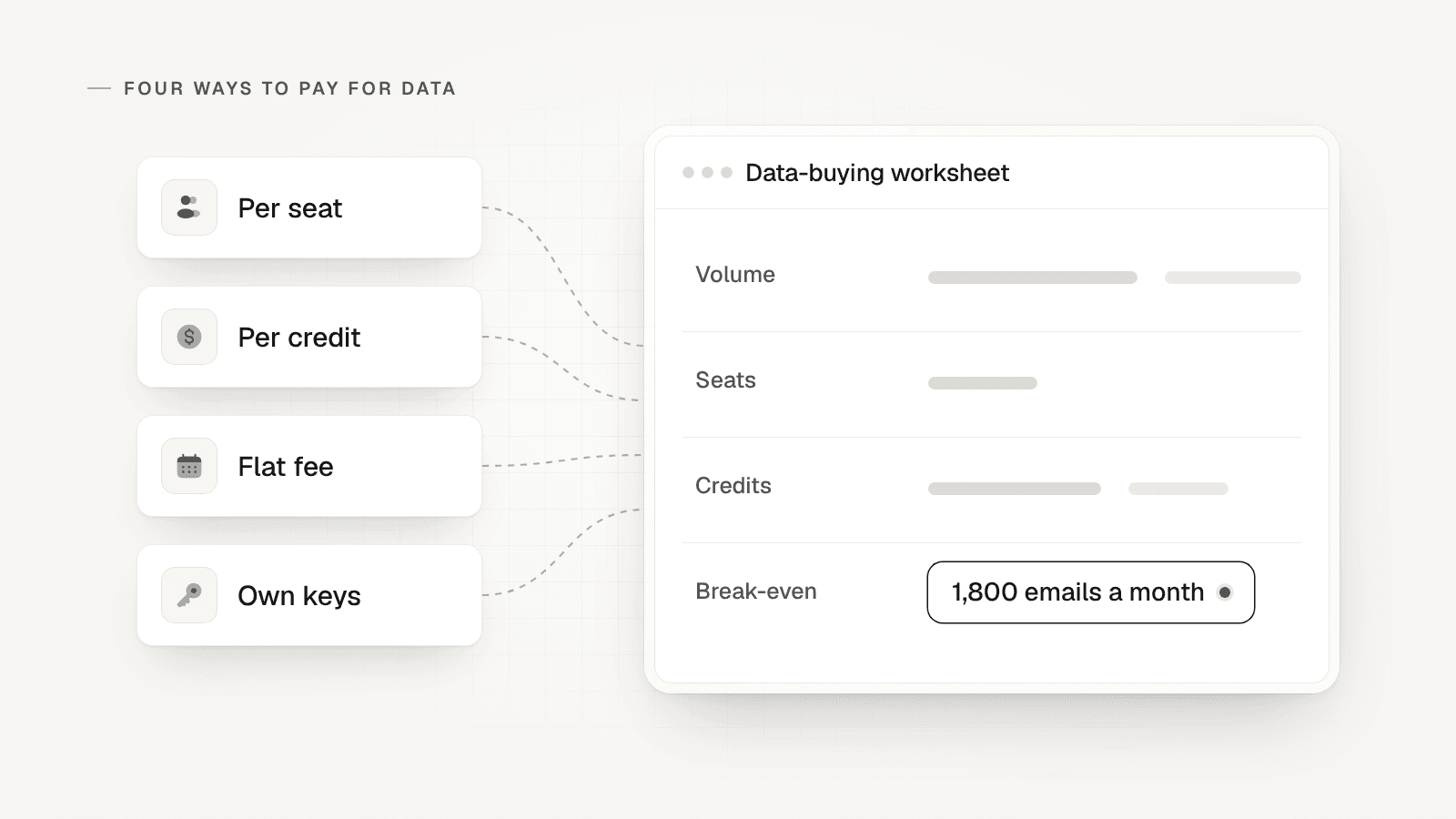
How are B2B data providers priced? Per seat, per credit, flat fee or your own keys
There are four, and each ties your bill to something different: headcount, reveals, a monthly cap or the plan you already pay for. A reveal is paying to see one contact's data. Every price here is a list price on 28 October 2026, before tax.

Read the small print too. Apollo.io's unused credits expire each billing cycle, while FullEnrich rolls them over for 3 months on monthly plans. Here is each model in detail:
- Per seat: Apollo.io Basic is $49 a seat a month billed yearly with 30,000 credits a year, or $65 monthly with 2,500 a month. An email is 1 credit and a phone number 8.
- Per credit: Lusha charges 1 credit per email and 5 per phone, nothing for no match. UpLead charges 1 credit per contact, email and mobile: $99 buys 170 a month.
- Per find: FullEnrich runs a waterfall and charges 1 credit per email and 10 per mobile, only when found. 1,000 credits cost $55 a month.
- Flat fee: BlitzAPI Start is $99 a month for up to 200,000 records under its fair use policy. A call that finds nothing counts nothing.
- Flat fee by speed: MoltSets starts at $27 a month for 1,000 records per 5 hours and 5,000 a week. Mobiles cost $0.15 each on top.
- Own subscription plus gap fill: keep the provider you pay for, and send only its misses to a waterfall that charges per find.
- On OXYGEN, own keys start on the $99 plan, and each successful own-key call pays its platform fee, even on a miss.
Sources: Apollo pricing, credits and FAQ, Lusha FAQ: data, credits, waterfall and compliance, UpLead plans and pricing, FullEnrich pricing in US dollars (its machine-readable page), BlitzAPI pricing and fair use policy, MoltSets pricing, MoltSets enrichment fair use policy, MoltSets home: phone tokens and FAQ
How do you fill in the data-buying worksheet?
Write five lines, then let the numbers pick the model. Redo the sheet when a price or your volume changes.
- 1. Volume: the work emails, mobiles and company records you need found each month. Count found values, not lookups.
- 2. Seats: the people who must log in. Under seat pricing, this sets most of the bill.
- 3. Credits: emails × email credits + mobiles × phone credits: 1 and 8 at Apollo.io, 1 and 10 at FullEnrich, 1 and 5 at Lusha.
- 4. Cost per model: seats × seat price, or the smallest credit plan that covers line 3. For the others, take the flat fee if you fit its cap, or your plan plus the misses.
- 5. Break-even: a fixed monthly fee ÷ the price per find you would pay instead. Above that many finds a month, the fixed fee costs less per value.
- Company data: free with a FullEnrich enrichment, 1 credit at Lusha, one record at BlitzAPI, and 1 to 8 credits at Apollo.io.
Sources: Apollo pricing, credits and FAQ, FullEnrich pricing in US dollars (its machine-readable page), Lusha FAQ: data, credits, waterfall and compliance, BlitzAPI pricing and fair use policy
What does an illustrative team pay under each model?
Take a made-up team of three reps that needs 1,500 work emails and 150 mobiles found a month. The volumes are illustrative, and each price assumes the provider has data for every contact.

Break-even: BlitzAPI's $99 ÷ FullEnrich's $0.055 per email on its 1,000-credit plan = 1,800 emails a month. One Apollo.io Basic seat at $49 billed yearly breaks even at about 890, and MoltSets Solo at $27 at about 490. A low price only pays off if the provider finds your buyers, so divide each cost by the values it really finds. Here is what the team pays under each model:
- Apollo.io Basic, per seat: 1,500 × 1 + 150 × 8 = 2,700 credits, inside three seats' 7,500. That is $195 a month, or $147 billed yearly.
- FullEnrich, per find: 1,500 + 150 × 10 = 3,000 credits. The smallest monthly plan that covers it is 5,000 credits for $255, and unused credits roll over 3 months.
- UpLead Plus, per contact: 400 credits for $199, plus 1,100 extra at $0.50, so $749 a month. Plus has one login; more seats come with Professional, by quote and billed yearly.
- BlitzAPI Start, flat fee: 1,650 records is far under its cap, so $99 a month. You need the API, and its phones are US numbers.
- MoltSets Solo, flat fee: $27 a month, plus $27 for 180 phone tokens, so $54. It is in public beta.
- OXYGEN credits, per find: about $311 a month (the $199 plan plus 8,600 credits in top-ups), each found email checked.
- Own subscription plus gap fill: three Apollo.io seats at $147 a month. Their misses, say 300 emails and 50 mobiles, use 300 × $0.085 + 50 × $0.99 in OXYGEN credits, plus checks.
- Those credits come with an OXYGEN plan, from $49 a month, or as top-ups at a higher rate.
Sources: Apollo pricing, credits and FAQ, FullEnrich pricing in US dollars (its machine-readable page), UpLead plans and pricing, BlitzAPI pricing and fair use policy, MoltSets pricing, MoltSets home: phone tokens and FAQ
Which buying model fits your volume?
Use your break-even and this rule, once a test shows the provider finds your buyers:
- Below the break-even, or volume that swings: pay per find. FullEnrich charges nothing for a miss.
- Steady volume well above it, inside a flat plan's cap: pay a flat fee, after reading its fair use policy.
- Reps who search in the tool every day: pay per seat, if the seat credits cover your mobiles.
- A provider that already finds most of your buyers: keep it, and fill only its misses per find.
- Any model: verify every email before you send. We treat that step as non-negotiable, because bad emails hurt deliverability, whether mail reaches the inbox.
Sources: FullEnrich pricing in US dollars (its machine-readable page)
How do you test a data provider on your own list?
Run the same contacts through two or three providers before you sign, and count verified, wrong and missing values apart. Our 100-contact switch test gives each step, with a rule you write first.
In OXYGEN, import the list as a CSV file. A free preview prices the Work email and Mobile phone columns, and Max credits caps the run. Each cell shows which provider found the value. A new workspace gets 250 credits once.
One provider or several? Waterfall enrichment explained
A waterfall asks one provider after another for the same field and stops at the first match. You reach several providers' data and, on per-find pricing, pay only the one that finds it.
FullEnrich runs one across 25+ sources and BetterContact across 20+. Apollo.io fills gaps from 20+ third-party sources, and Lusha checks outside providers when it has no match, on Pro and above.
OXYGEN's waterfalls try up to 17 email and 13 phone providers, on its credits or your own keys. Managed finders charge only when they return a value, but a row can cost credits without one:
- Guessed addresses: a row with a name and domain but no LinkedIn URL first checks up to eight guessed emails. Each check costs about $0.00225, valid or not.
- Failed checks: an email that fails verification still bills its finder and the check.
- Own keys: from the $99 plan, each successful own-key call pays OXYGEN's platform fee, even on a miss. Waterfalls has the full rules.
Sources: FullEnrich pricing in US dollars (its machine-readable page), BetterContact pricing and waterfall, Apollo data and waterfall enrichment, Lusha FAQ: data, credits, waterfall and compliance
Is buying B2B contact data legal?
It can be, but privacy law still covers business contacts. The UK regulator, the ICO, says the UK GDPR applies to personal data used for direct marketing, even in a business context.
Under PECR, the UK's e-marketing rules, email to companies needs no consent, but email to sole traders and some partnerships usually needs consent. Data from a third party means telling people within one month.
The EU's GDPR sets the same one-month limit (Article 14) and lets anyone object to direct marketing (Article 21). The CCPA's exemption for business-to-business personal data in California expired on 31 December 2022. Since 1 August 2026, data brokers must process deletion requests from the state's DROP platform at least every 45 days.
Cognism and Apollo.io say they rely on legitimate interest, a lawful basis that weighs a business need against a person's rights. Your own use still needs a lawful basis and an opt-out. This is not legal advice.
Sources: ICO: business-to-business marketing, EUR-Lex: General Data Protection Regulation (EU) 2016/679, California Attorney General: CCPA, California Privacy Protection Agency: data brokers and DROP, Cognism compliance: GDPR, CCPA and do-not-call lists, Apollo B2B data: sources, coverage and GDPR
What OXYGEN does not do here
- No contact database of its own: every value comes from a data provider, on OXYGEN's credits or your keys.
- No published match rate. How many contacts a waterfall finds depends on your list.
- A work email miss is not always free: guessed-address checks bill each check.
- Own keys need a paid plan, and a credit cap does not limit what your provider bills you.
Frequently asked questions
What is the best B2B data provider?
The one that finds your buyers, in your countries, at your volume. By their own accounts, Cognism suits phone-led teams and Lusha a free test. Apollo.io suits reps who want data and email outreach. Test two or three on the same contacts first.
Who are the biggest B2B data providers?
By the counts they publish: RocketReach 700M profiles, Lusha 515M+ contacts, ZoomInfo 500M+ professional profiles and Apollo.io 240M+ contacts. Each counts something different, and none was tested for this page.
Which data provider has the best mobile numbers?
No single answer holds for every country. Cognism says its mobiles are phone-verified, Lusha publishes its own phone accuracy figures, and Kaspr calls Europe its home. Count wrong and missing numbers on your own sample.
How much does B2B contact data cost?
It depends on the model and the field. An email usually costs 1 credit, and a phone number 5 at Lusha, 8 at Apollo.io and 10 at FullEnrich. ZoomInfo's sales packages and Cognism are priced by quote. The worked example above prices one team per model.
Is ZoomInfo a data provider?
Yes. ZoomInfo sells contact and company data per seat, plus credits for exports, and prices its sales packages by quote. ZoomInfo Lite gives new users limited free use in exchange for business data. ZoomInfo pricing explains what drives a quote.
What mistakes do teams make when buying B2B data?
Buying seats for people who need few lookups, and judging database size over coverage of their buyers. Forgetting that a phone costs 5 to 10 times an email in credits. Letting credits expire, and skipping email verification to save money.
Are B2B data providers GDPR compliant?
Several say so on their own pages, but that does not make your use compliant. Cognism says it relies on legitimate interest and notifies people in its database. You still need your own lawful basis, privacy notice and opt-out.
Related
Sources
- Tim Scheuer on LinkedIn: six trends from studying 80+ GTM tools (August 2026), checked October 28, 2026
- Tim Scheuer on LinkedIn: the 9-step GTM framework (August 2026), checked October 28, 2026
- ZoomInfo pricing FAQ, checked October 28, 2026
- ZoomInfo pricing and packages, checked October 28, 2026
- ZoomInfo: our data, with counts by region, checked October 28, 2026
- ZoomInfo: data sources, checked October 28, 2026
- ZoomInfo Lite FAQ, checked October 28, 2026
- Apollo pricing, credits and FAQ, checked October 28, 2026
- Apollo B2B data: sources, coverage and GDPR, checked October 28, 2026
- Apollo data and waterfall enrichment, checked October 28, 2026
- Cognism pricing: Standard, Pro and credits, checked October 28, 2026
- Cognism: about our data, checked October 28, 2026
- Cognism integrations, checked October 28, 2026
- Cognism compliance: GDPR, CCPA and do-not-call lists, checked October 28, 2026
- Lusha pricing, checked October 28, 2026
- Lusha FAQ: data, credits, waterfall and compliance, checked October 28, 2026
- Kaspr pricing, checked October 28, 2026
- Kaspr: our data and its sources, checked October 28, 2026
- Kaspr integrations, checked October 28, 2026
- UpLead plans and pricing, checked October 28, 2026
- UpLead: our data and how it is collected, checked October 28, 2026
- RocketReach pricing and FAQ, checked October 28, 2026
- RocketReach home: profiles and companies, checked October 28, 2026
- FullEnrich pricing in US dollars (its machine-readable page), checked October 28, 2026
- BetterContact pricing and waterfall, checked October 28, 2026
- BlitzAPI pricing and fair use policy, checked October 28, 2026
- MoltSets pricing, checked October 28, 2026
- MoltSets enrichment fair use policy, checked October 28, 2026
- MoltSets home: phone tokens and FAQ, checked October 28, 2026
- ICO: business-to-business marketing, checked October 28, 2026
- EUR-Lex: General Data Protection Regulation (EU) 2016/679, checked October 28, 2026
- California Attorney General: CCPA, checked October 28, 2026
- California Privacy Protection Agency: data brokers and DROP, checked October 28, 2026
Updated October 28, 2026. OXYGEN's own prices and limits come from the product and its live price list. The other products named here are trademarks of their owners and are not affiliated with OXYGEN. Something out of date? Tell us.